

Quick List
‘On Why You Should Just Get Started’ by Ansh Jain.
‘The Case for Writing for Yourself Before Niching Down’ by Mishti Sharma.
‘How to Fight Self-Rejection & Cringe to Hit Publish on Linkedin’ by Yours Truly.
How to Avoid 10 Beginner Writer Problems — the Nicolas Cole Way.
‘The 19 Checklist to Improve Your Linkedin Writing’ by Dickie Bush.
‘How to Be Original When Anything Can Be Prompted’ by Harsh Snehanshu.
‘To Write Originally, Keep Chasing Your Voice’ by Nicholas Mlakar.
‘On Writer’s Block for Someone Who Writes Everyday’ by Harsh Snehanshu.
‘How to Deal with Social Media Engagement Envy’ by Mike Rosenberg.
‘What happens if you write regularly for a year on LinkedIn’ by Mike Rosenberg.
You’re reading Edition 1 of ‘The Writer’s Craft’ - Fortnightly interviews featuring Journalists, Online Creators & Newsletterists: Tips on how to tell your story so you can build authority through LinkedIn & Newsletters.
“Dude, you should start writing on LinkedIn!”
I tell this to many of my close friends.
I’m truly blessed to have friends who are engineers, people in arts and humanities, and academia. They are a walking library of wisdom.
“You’re doing an injustice to not share your ideas by writing online!” I say.
They respond:
“Okay, how do I start?”
“I feel shy… I’m a bit nervous.”
“I find it hard to be consistent.”
“I don’t really have any ideas.”
“Do I need to take a course?”
Keeping all these questions in mind, I cherry-picked popular LinkedIn writers I follow and, of course, they’re ones who don’t use AI for their writing.
Listed below are the best advice you ever need to get started. Let’s dive in!
‘On Why You Should Just Get Started’ by Ansh Jain.

Ansh is right to say people do write anything.
I kid you not, Harsh Snehanshu, Founder of Pint of View & YourQuote, shares poetry.
The engagement is just ridiculously good. So yeah, you can truly write anything! (As long as you are not an idiot and write hateful stuff)
‘The Case for Writing for Yourself Before Niching Down’ by Mishti Sharma, Head of Narratives at Clay

“Niche down before you start writing.”
“Know your audience and then build your reader community.”
These are obvious guidance given by creators, but the purpose of writing is the pursuit of knowing who you are and making sense of what is in our mind — rather than filtering in the air what is stored in our mind, and then writing about it.
The latter process results in frustrated writing, but writing with the intent of exploring, like a cartographer, is magic. Herein lies your truest version of yourself, spoken in words that exist in you, and hence Mishti’s take makes so much sense:
“…if you’re going to write publicly, it has to be for YOU. Use it to clarify your thinking, enjoy some self-expression, and attract kindred spirits.”
So go crazy as an explorer and then pitch a flag in the island of what you truly care about. Keep doing this for days, weeks, or even months.
You’ll know soon enough what you love writing about and that’s when you niche down and explore this island.
That’s when templates like Business Model Canvas or design thinking frameworks might help you to become a niche thought leader/writer in your line of work.
Self-rejection and cringe are real. Here is how you fight.

I have over 5,000 LinkedIn followers. The figures could have been way higher if I was more confident, bold, and fearless. Alas, I’m a human after all and just like most writers, there are good days and bad days.
In this piece, I asked popular LinkedIn writers — with followership as large as over 1 lakh to a few thousands — what gives them the energy to actually smash the post button. The answers are optimistic and some might surprise you.
How to Avoid 10 Beginner Writer Problems — the Nicolas Cole Way.

I have huge respect for Nicolas Cole. The above post offers practical mindset one can adopt if you are a beginner writer looking to build your LinkedIn community.
Nicolas’ writings offered me a clear framework on how to become a ghostwriter.
Do read his book, “The Art and Business of Online Writing: How to Beat the Game of Capturing and Keeping Attention”.
I have personally used his pitching and pricing models to earn ghostwriting clients with fair success.
‘The 19 Checklist to Improve Your Linkedin Writing’ by Dickie Bush

Dickie Bush is Nicolas Cole’s ghostwriting business partner, and he is equally talented. The post might say: How to go viral on LinkedIn.
However, I strongly urge newbie LinkedIn writers not to start writing with the intent of going viral. Rather focus on the quality of your writing and following this 19 checklist.
If repeated consistently, then the odds can be in your favor for one of your posts to go viral. Remember… Quality Writing + Consistency + Volume = Organic Virality.
Join My WhatsApp Channel to get curated readings. No spam. Just Wisdom.
‘How to Be Original When Anything Can Be Prompted’ by Harsh Snehanshu
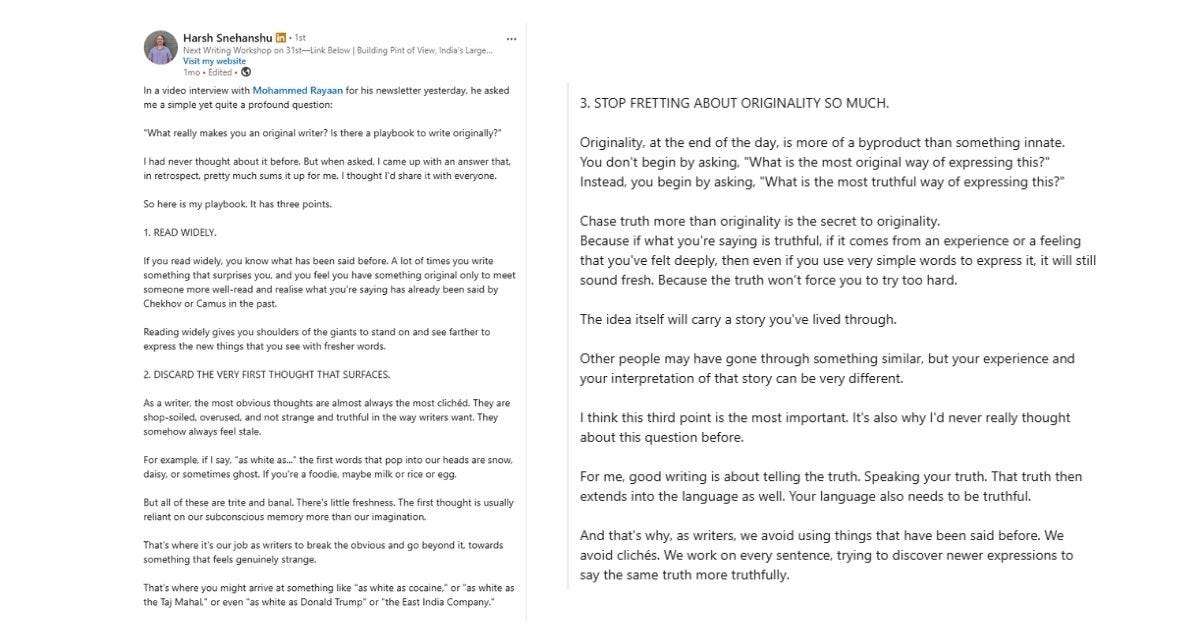
For a soon to appear interview in this newsletter, Harsh Snehanshu responded to my question — “What really makes you an original writer? Is there a playbook to write originally?” — as a post. He summarised his playbook in three core points.
Read Widely.
Discard the Very First Thought That Surfaces.
Stop Fretting About Originality So Much.
Read it above or else go here.
‘To Write Originally, Keep Chasing Your Voice’ by Nicholas Mlakar

Writers should keep chasing their voice to become better writers.
I would die on this hill, but if you use AI, then it’s a guaranteed way to kill your voice 10X faster.
If you read the writers you love and keep their writing style as your north star, then you are bound to build your own voice in time.
A reminder again: do not, for the love of God, use AI.
‘On Writer's Block for Someone Who Writes Everyday’ by Harsh Snehanshu
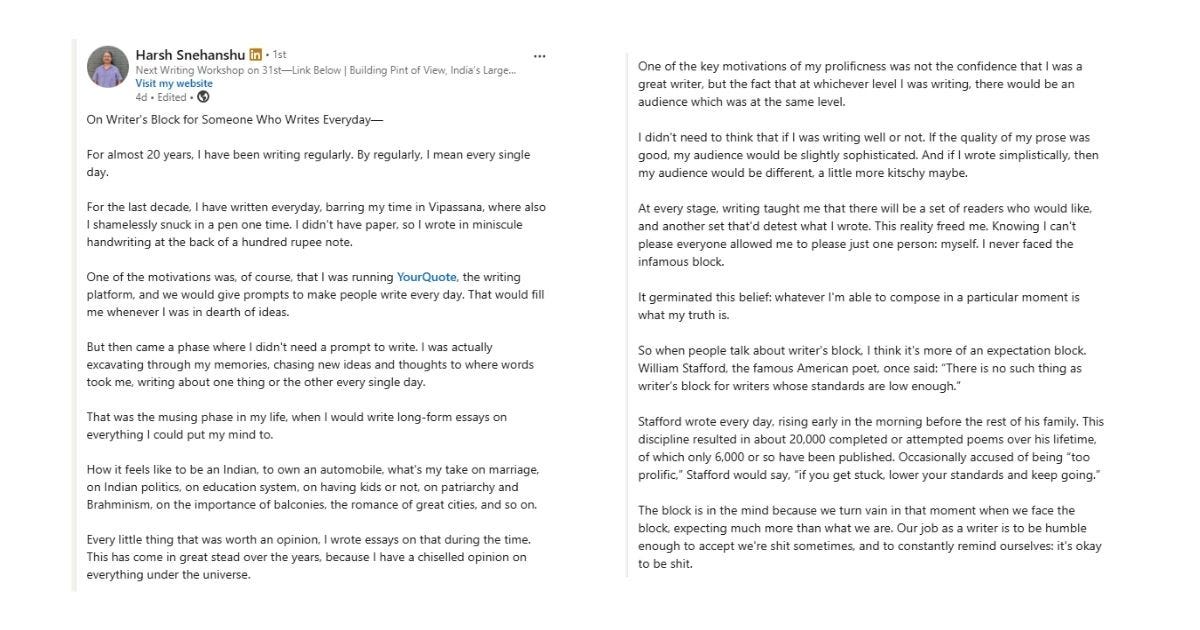
One of the best ways to fight writer’s block, honestly, is to really write bad and have the courage to share your bad writing, even if it sounds generic.
The more you do this, the easier it gets to write whatever you want to write.
Read earlier editions of The Fiction Emailer:
‘How to Deal with Social Media Engagement Envy’ by Mike Rosenberg.

I used to get annoyed whenever I stumbled upon generic posts with dozens of likes. It would piss me off, and I would wonder: should I do the same?
Social Media Engagement envy is a real thing, but envy in any form has a price to pay. It eats you from the inside. I’d spend time criticizing such posts. The more I criticized, the less I was posting my own writing. SM Engagement envy is a jealousy toxic mess. It clouds you from actio1n — from working on your own art, you are writing, your work.
How do you get away from this SM engagement envy trap?
It takes constant effort.
When your purpose of writing on LinkedIn is more so for understanding who you are, what’s on your mind, what you truly care about, and helping someone out, then the universe tends to work in your favor.
Your writing will attract opportunity.
Your writing will attract friends and mentors who will root for your success.
Your writing will attract leads you dreamt about.
Social media pundits might say that this is how the algorithm works, but good karma transcends across platforms. Just write with the intent to help someone, and the rest will follow. The SM engagement envy won’t ever bother your mind.
‘What happens if you write regularly for a year on LinkedIn’ by Mike Rosenberg.

I can’t stress enough how writing in public opens doors of opportunity beyond your wildest imaginations. This post above is 1 in 100 such examples of many writers who share their success story.
But remember: success only knocks on your door if and only if you write in public.
And that’s all for today!
Reach out to me on LinkedIn to say HI if you need help to grow your writing.
You can simply reply to this email or comment below. See you soon! 😊❤️
I’m sorry friend but do we think what works on LinkedIn will work here too? And why are we bringing back the link-sharing again?