

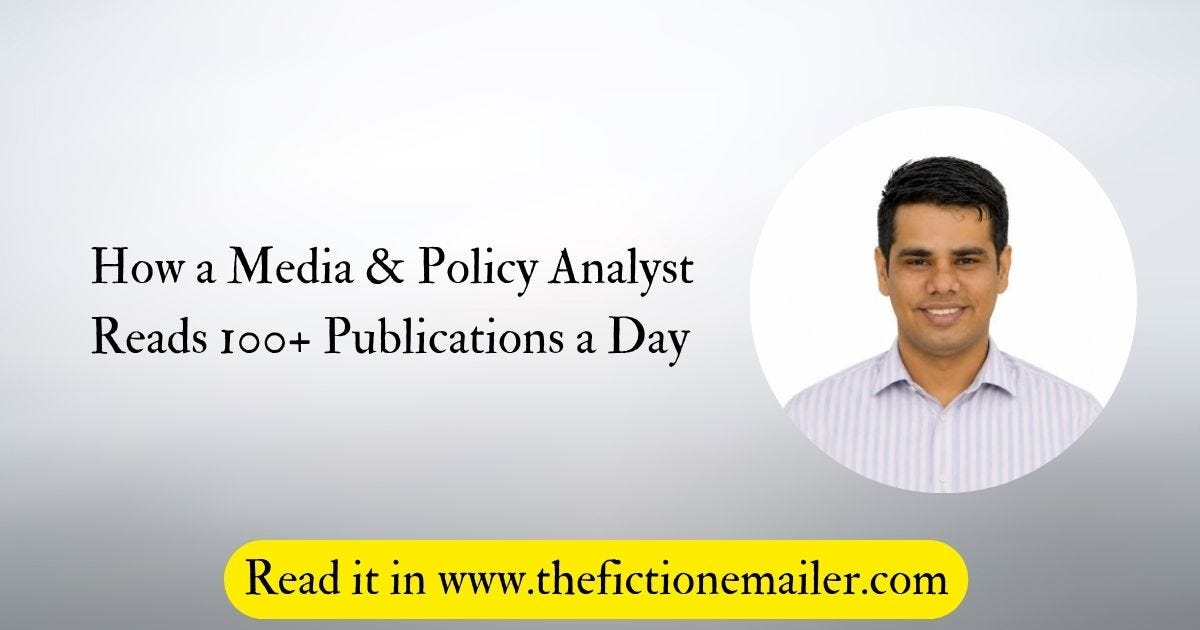
Key Takeaways | Interview with Vikas Lohchab
“Do not feel pressured to scan dozens of papers immediately; instead, choose one domestic and one international publication to read deeply.”
“One can start [reading] by dedicating a fixed 30 minutes each morning to a single publication, slowly expanding your catalogue.”
“Treating reading as an active research exercise — where I actively look for hidden patterns — completely neutralises the urge to mindlessly scroll.”
“I primarily use digital aggregators like Magzter and PressReader to streamline my reading, which allows me to flip through multiple global papers efficiently.”
Welcome back to Edition 5 of ‘The Long-Term Game’.
Learn how accomplished founders and professionals write & think to build their niche expertise, and apply the same frameworks yourself.
What do I write about?
A million articles answers this question. Yet a million more will be published.
“So what do I really write? Something to get started?” my ghostwriting clients ask me.
As founders of several businesses, I understand their quizzical look.
“Start with the low-hanging fruit,” I say. “Share about things you read.”
If you’re a founder with zero online presence trying to figure out how to think like a thought leader, Vikas Lohchab’s morning routine is a good place to start. This guy reads 100+ Indian and international publications everyday!
Vikas brings 7+ years of experience in tech governance, geopolitics, and regulatory monitoring as Media & Policy Analyst. He’s a Research Associate at the Institute for Governance, Policies and Politics (IGPP) in New Delhi, and is preparing for the UPSC Civil Services Examination. He has over 14,000 LinkedIn followers+.
You don’t have to read a hundred newspapers like me, but you should get started with one, says Vikas. This will help you understand how the world works around us.
His tips are helpful if you are a founder looking to share your POV online as a writer.
So let’s dive in!
Join My WhatsApp Channel to get curated readings. No spam. Just Wisdom.
The Full Q&A
Tell us about yourself
I am a New Delhi-based media and policy analyst with seven years of experience across public affairs, politics, and AI governance frameworks. Currently working as a Research Associate at the Institute for Governance, Policies & Politics (IGPP), I focus on uncovering the deeper patterns behind daily developments. My complete fluency in both English and Hindi allows me to track grassroots political mobilisation that others often miss.
How do you read?
My approach to reading is highly analytical and systematic, focusing heavily on structural patterns rather than surface-level headlines. I dissect complex political, regulatory, and geopolitical shifts to transform raw text into structured, actionable insights. By balancing both English and Hindi sources, I ensure my reading covers everything from elite policy debates to grassroots movements.
How do you go through multiple newspapers a day?
To maintain a comprehensive global perspective, my daily routine involves scanning more than 100 Indian and international publications. I accomplish this by filtering information efficiently, bypassing sensationalism, and looking strictly for systemic regulatory changes and geopolitical shifts. This extensive tracking forms the baseline of my institutional research and policy analysis.
Do you use a news aggregator app, or do you go through each publication’s website manually?
Yes, I primarily use digital aggregators like Magzter and PressReader to streamline my reading, which allows me to flip through multiple global papers efficiently.
Alongside these, I rely heavily on major news wires such as the Associated Press, Press Trust of India (PTI), Reuters, and Bloomberg, complemented by Yahoo News and Yahoo Finance for real-time updates.
When it comes to browsing individual websites, I generally prefer checking the direct feeds of these wire services rather than manually visiting every single publication’s site. It is a much quicker way to get an unfiltered, cross-border view of breaking stories.
Rayaan Writer’s Note: I use British Council Library’s digital subscription, and it is worth the money as it includes PressReader and 100+ global newspapers.
What is your favourite reading habit?
My favourite reading habit revolves around marginalia and active text synthesis. I prefer scribbling notes directly onto the margins of pages and documents to capture immediate analytical thoughts, rather than using a standard yellow highlighter.
These scattered notes are later compiled into a structured, centralised notebook, converting raw observations into formal policy insights. I truly believe this approach benefits everyone in the long run.
Read earlier editions below:
How do you build the habit of sharing different articles on your LinkedIn?
Sharing independent commentary on LinkedIn has become a natural extension of my daily research routine.
Once I synthesise complex regulatory moves or parliamentary tracks into structured insights, I share them for professional discourse, especially since LinkedIn is an unparalleled platform for interacting with executives directly.
Consistently publishing these takeaways keeps me accountable and ensures my network of nearly 12,000 folks’ benefits from grassroots and global policy analyses.
How can someone build a newspaper or a book reading habit?
Building a sustainable reading habit requires moving away from fleeting daily headlines to focus on the broader narratives behind them.
I actually started reading newspapers back in my school days when I only had two options: Punjab Kesari and Dainik Bhaskar. When I moved to Delhi in 2016, I graduated to The Hindu and The Indian Express, so it is simply second nature now.
One can start by dedicating a fixed 30 minutes each morning to a single publication, slowly expanding your catalogue. Pair this with books that provide historical context to let your curiosity drive the habit.
While I do not read books as much these days — though I am currently reading The Digital Decades by Subimal Bhattacherjee — I focus heavily on magazines. The Economist, Bloomberg, The Atlantic, The New Yorker, Frontline, The Week, Fortune, Forbes, and Outlook are among my favourites.
How do you fight distraction from social media when reading?
Fighting digital distraction requires a deliberate commitment to deep, structured analysis over low-quality, algorithmic feeds.
I insulate my reading time by strictly focusing on primary legislative texts, parliamentary tracking, gazettes, Press Information Bureau releases, independent policy think tanks like NITI Aayog, and reputable international publications.
Treating reading as an active research exercise — where I actively look for hidden patterns — completely neutralises the urge to mindlessly scroll.
Tips and advice for newbie readers getting started
For those just starting out, I highly recommend focusing on quality over sheer volume, as information overload can easily cloud your judgement.
Do not feel pressured to scan dozens of papers immediately; instead, choose one domestic and one international publication to read deeply.
It has taken me ten years to reach my current scale. Train yourself to look past the dramatic headlines and try to identify the underlying political or economic factors driving the story.
As someone who regularly tracks the world’s current affairs, how can one develop the habit of predicting the possible outcomes of global events such as politics, health, and geopolitical issues?
Predictive capacity is developed by studying the deep patterns behind daily events rather than treating incidents in isolation.
By consistently tracking institutional frameworks, domestic regulations, and historical precedents, you will naturally begin to spot repetitive behaviours in governance.
Ultimately, combining international policy shifts with local grassroots realities allows you to accurately anticipate how leaders and populations will react to future crises.
Could you explain this “pattern recognition” a bit further?
In my view, regardless of your profession, once you have spent enough time in a field, you naturally start spotting patterns and anticipating what comes next.
For instance, if you have spent years covering politics, you develop an intuitive sense for how an election might swing based on subtle shifts in public mood or party strategy. The same rule applies to journalism.
After years of reporting and analysing events, you stop looking at stories in isolation. You begin to understand the why behind them — who is driving the narrative and what their underlying motives might be.
It isn’t a mystical gift; it is simply structural awareness built from years of hands-on experience, allowing you to connect the dots and forecast the most likely fallout in the days or weeks ahead.
And that’s all for today!
Need help to scale your LinkedIn? Let’s Chat
You can simply reply to this email or comment below. See you soon! 😊❤️