

Welcome to the Fiction Emailer: A newsletter that aims to make sense of our chaotic world through the lens of ‘Speculative Journalism & Fiction’ by rayaan_writer. Find here long-form essays and interviews that will help you think clearer, read sharper, write better, and look forward to an optimistic future. Visit my site to know more.
Important: I’ve moved my site from Beehiiv to Substack for now.
Join My WhatsApp Channel: Every other day, I send you one article worth your time… curated for people who think before they scroll. [Link]
Last week, my home state Tamil Nadu elected popular movie star C. Joseph Vijay as the Chief Minister.
Newspapers are flooded with a million opinion pieces on:
How Vijay’s fandom launched TVK into power
How the duopoly of AIADMK and DMK was broken
How cinema and politics go hand in hand
Political pundits postulate that Vijay was a cinematic hero who made his mark on screen as a commoner or an elder brother. Millions found themselves in the character of his movies and eventually voted him to power with the hope to bring a change in the Dravidian politics that has existed for decades in the state.
The underlying theme in many of the op-eds was ‘Hero’. Every fiction story has a hero. Every true story has a hero element too. As writers, the concept of what makes a hero a ‘hero’ is often studied from their journey to their flaws, to their path of hunting side-quests, and finally to their redemption or victory.
I am not a political journalist, nor am I writing for a newspaper full time. But using the frameworks of speculative journalism and speculative fiction, I try to make sense of the world around us. In this edition, I wanted to explore ‘Hero’ in writing.
Why Grace & Humility In Writing Is Important
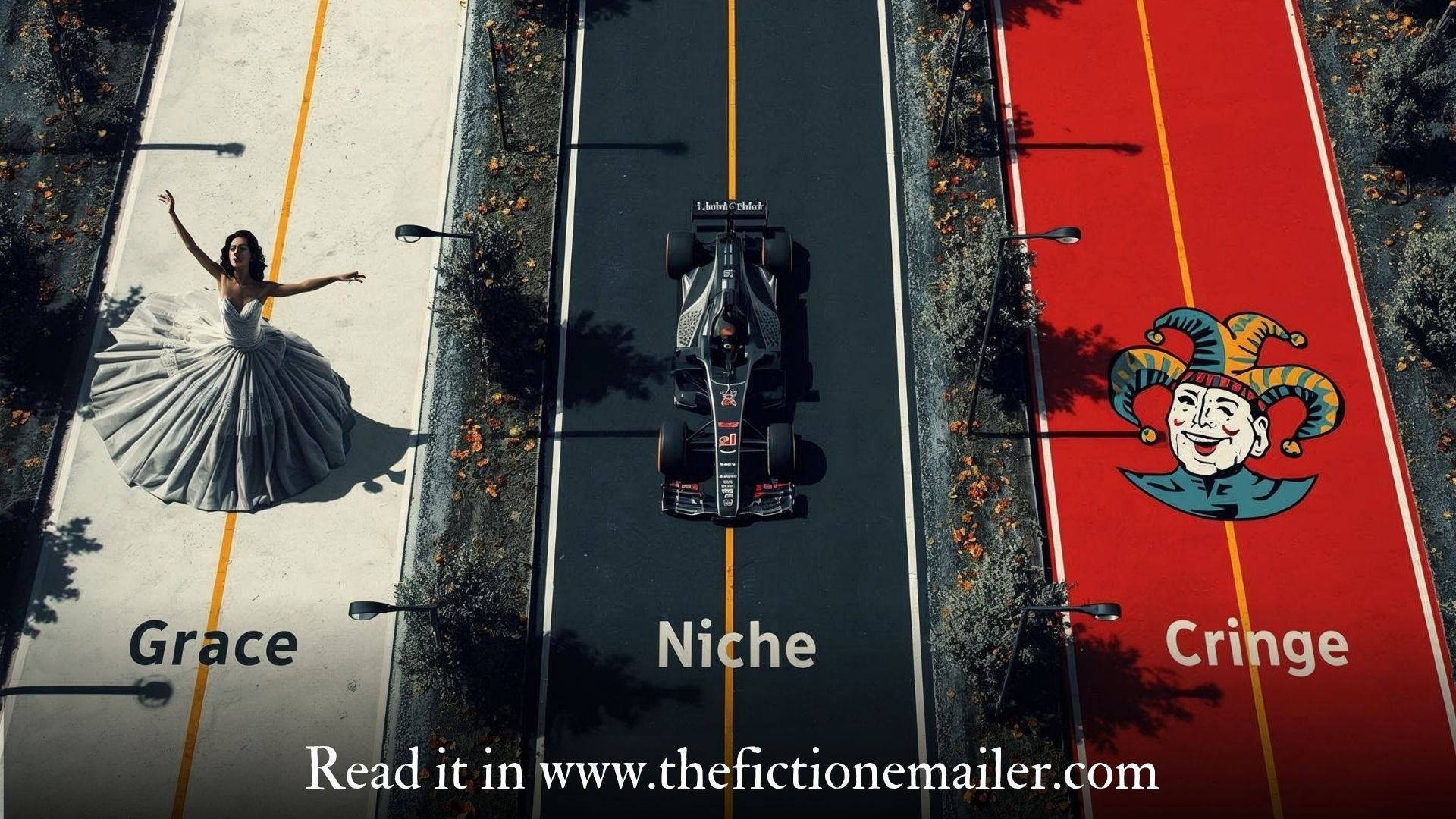
Grace and humility are the anchors that keep you afloat every time a rough wave of arrogance — knowing your niche too much — tries to rock your boat. These virtues help you stay humble and aware that there is always an uncharted island in your topic yet to be explored.
So how do we get this?
You start with the ‘hero element’. Every bit of writing we do should have the ‘hero element’. The ‘hero element’ is the niche of work we select and its target community. Smart public thinkers and professionals have cracked this code in a simple yet effective way on LinkedIn.
Take Maggie Blackburn on her LinkedIn. She runs Portfolio Career Strategist & Coach, and runs the ‘Feeling Free’ Newsletter. Her LinkedIn Banner is a pretty cool template of how to say a lot with less. It has who she is, what she does, how she helps, her newsletter shoutout, and the companies she has worked with. It is a very visible north star we can follow. What Maggie’s banner proves is this: when you are clear about who your hero is, your positioning writes itself.

The hero section on your personal website should do the same. Additionally, you have a chance here to address your value system — the type of work you do, the people you enjoy working with, and the impact or transformation you offer.
Many times when we start writing in public, we often end up imagining ourselves as the ‘ultimate, unharmed hero’ of our niche. Think of all your favourite movies and you will agree that in the beginning, the hero is shown to be victorious only to be slapped with a big rejection, a heartbreak or a death. This then changes the hero’s path to a road unknown. So don’t have the ‘ultimate, unharmed hero’ mindset when you begin, as this might prevent us from learning deeper — the arrogance of being overconfident of a topic that you pick could be a real hurdle.
Thus, it is ideal to centre your writing at the hero of your niche: the community interested in this topic. When we treat our audience as our heroes, we go deep into their topic, the problems they face, the solutions that already exist, and how we can offer a different perspective and take.
To bring this out in your writing, the best trick to adopt is to share your writing or talk about the ideas in draft with your family, a friend, a spouse, sibling or your parents. When these are the people you think of as your first reader, you adopt an easy to understand writing style. Since you are writing with the lens of grace and humility, you won’t have the arrogance of being niche smart. Remember: our job as writers is to help our audience become heroes themselves.
Hero’s Journey: How to cast a wide net under ‘Generalised Niche’
Over the years working as a journalist, I always come across people desperate to start writing. They have built successful teams, minted a lot of money, and led projects to great deals. They have all the time and attention to reach this state but so little time to put down a word on paper — to write and to live deeply.
Last year when I became an indie ghostwriter and spent redesigning my website rayaanwriter.com, I kept my focus on addressing the needs of such individuals. I wanted to help boomer founders and entrepreneurs running great offline businesses but with near zero online presence, especially on LinkedIn.
To reach this stage of niching down, I knew early that I should not mummify myself into a creative coffin and rather be a cartographer with maps to fly beyond known quarters.

In ‘How Great Ideas Happen’, author George Newman asserts that genius artists are not creative individuals who had one light bulb moment after another but rather were creative explorers consistently trying to fuse several light bulbs that fail to fuse. These are folks who spend time spinning the wheel in a different direction instead of creating a new wheel altogether. Their joy of work comes in the journey of discovery which eventually leads to creation.
In his essay on genre research for fiction (Genre Fiction Market Research 101: How To Find Profitable Categories & Cater To Readers), Nicolas Cole demonstrates how to find a niche. He selects a wide umbrella genre, pins it down to a category that has been steadily growing, and finally goes into a specific sub-niche.

I have always been interested in how journalistic practices and principles can be replicated in other forms of writing too. I have also been someone who is interested in fiction. So speculative journalism and speculative fiction is the umbrella topic I am using to spread my wings wide: to write about writing, thinking, reading, and how to create impact using this framework.
Looking back, to be a creative explorer as a writer is like being a professor with a chalkboard: you erase, you write, you explain, and repeat. When somebody asks a question you were never asked before, you are allowed to fumble, because writers who dare enough to write about a topic they are uncomfortable with are the ones who crack the code to find their voice. That is part of the hero’s journey as a writer. But do know when to niche and when to continue exploring. Keep writing, and keep talking to people who belong to the niche.
Do we have a recipe to dealing with ‘cringe’
I always have this cringe feeling about what people in my LinkedIn network think whenever I share something. This cringe feeling is like a stock market. There are good days. There are bad days. It climbs up and down like the AI stocks that investors see every week on their screens.
There are weeks when I struggle to be consistent because I feel people will think I am writing for the sake of writing, rather than writing with the intent of actually offering something valuable. There is an imposter feeling I sometimes carry, when I feel I still need more experience before I am allowed to write. I worry the writing is too generic, or that the perspective has already been shared by other thought leaders or writers or thinkers online. This feeling bogged me down even when I was writing regularly and had many articles and feature stories coming out, especially in my first job at News Today and Talk Media.
Whenever I struggle to hit the publish button, I often ask my brothers to give me feedback on my writing. Earlier, I used to send a huge draft and tell them to read. Now I just bounce ideas off of the essays I am drafting to write. I tell them what I am looking to explore and then I hear their perspective. I always find it interesting to get a take from someone in an entirely new field of work. It is like tasting exquisite dishes at a buffet, with each one offering an euphoria of delight to your tastebuds. When you chat with people of varied professions, you are bound to unlock a treasure box of questions that arrive in a sealed envelope of “Whoa! Why did I not think this before?!”
Speaking with my brothers often leads me to think with hope. Whenever I write with hope, I use words that open doors of possibilities I never thought before. When I write with the lens of opening doors of possibilities, I imagine that I am offering a key to my newsletter readers to several unexplored doors of ideas that they can walk through and perhaps experiment with themselves.
Nevertheless, I still do have the cringe feeling when I try to hit publish. The sense of having the cringe may always linger. But it is a bit less after ideating with my brothers than before.
I asked the same question to many of my accomplished mentors: do they go through this feeling too when they have to share their work?
My good friend H.R. Venkatesh, a senior editor, anchor and reporter whose superpower — according to his LinkedIn — is that he forges communities, collaborations, consensus and partnerships, and likes to write about what he is thinking.
Venkatesh, who is now building the next IJNet at the International Center for Journalists (ICFJ), told me: “It is good to have this feeling, but don’t ignore it and at the same time don’t give in to it.”
And that’s all for today!
Did you like reading this edition? Should I do better? Please don’t hesitate to offer me your feedback. I am open to ideas and suggestions.
Feel free to reach me at rayaanjournalist@gmail.com or you can simply reply to this email or comment below. See you soon! 😊❤️
That reminds me, I have to talk to you about that feeling of cringe! More later...