

Welcome to the Fiction Emailer: A newsletter that aims to make sense of our chaotic world through the lens of ‘Speculative Journalism & Fiction’ by rayaan_writer. Find here long-form essays and interviews that will help you think clearer, read sharper, write better, and look forward to an optimistic future. Visit my site to know more.
Join My WhatsApp Channel: Every other day, I send you one article worth your time… curated for people who think before they scroll. [Link]
Elegant Writing Needs Harder Reading, Tougher Questions
I’m a journalist. I’m also a ghostwriter helping boomers with successful offline businesses but zero online presence to build their digital legacy on LinkedIn or a newsletter. These are busy folks wanting to transform their career stories into impactful pieces of writing.
To learn about my client’s industry, I spend hours researching the works of other entrepreneurs and thought-leaders. One of my clients is a former CTO at a major tech firm now running an AI consultancy business. I scour through journals explaining Large Language Models, I sniff whatever economists predict about AI stocks, I scoop my email for newsletters suggesting best prompts to use. I spot Google trends to track breaking stories from Silicon Valley by tech reporters.
For another client, a bespoke tailor, I dove into the world of fabrics, fashion, stitching, designing and everything in between. My browser had a gazillion tabs open from fashion websites to style guides to documentaries on dyeing factories.
This is the part of grunt work that I won’t offload to an AI chatbot for now. They can be faster but they don’t have my taste to filter out the best as doing this boring process is what helps me ask my clients solid questions. Thus, deep reading aids me to get the vocabulary used by industry veterans, trends they expect, learnings and mistakes they made, and what makes them love what they do.
Importantly, it directs me with the right questions to ask my clients, alongside the Speculative Journalism & Speculative Fiction frameworks I use. Therefore, when we sit down for an interview, they respond with sharper answers. After hours of editing their replies, it transforms into writing that goes out from their social accounts. This is my ghostwriting job in a nutshell with deep research and reading being a crown part of the process. This leads me to…
If It Is Easy to Read, Then It Was Hard to Write
A core brain muscle building activity that I do to sharpen my writing craft is to read tough pieces of writing, especially in STEM (Science, Technology, Engineering, Mathematics) and humanities. I get to learn how to explain a complex topic in the most simplified manner.
I follow NatGeo, Scientific American, Asmiov Press, Aeon Mag, etc. I often read their pieces 2-3 times owing to the complexity of the themes they cover. The first attempt is a quick eye glance, the second read is to get a hold of the writing style, and the third reread is when I actually get a grip of the subject.
Thanks to my ex-roomie and great friend at Ashoka University Abhigyan Ray, I was introduced to Quanta Magazine – reporting high quality journalism in science and mathematics. Reading Quanta unlocked the fear I had for math.
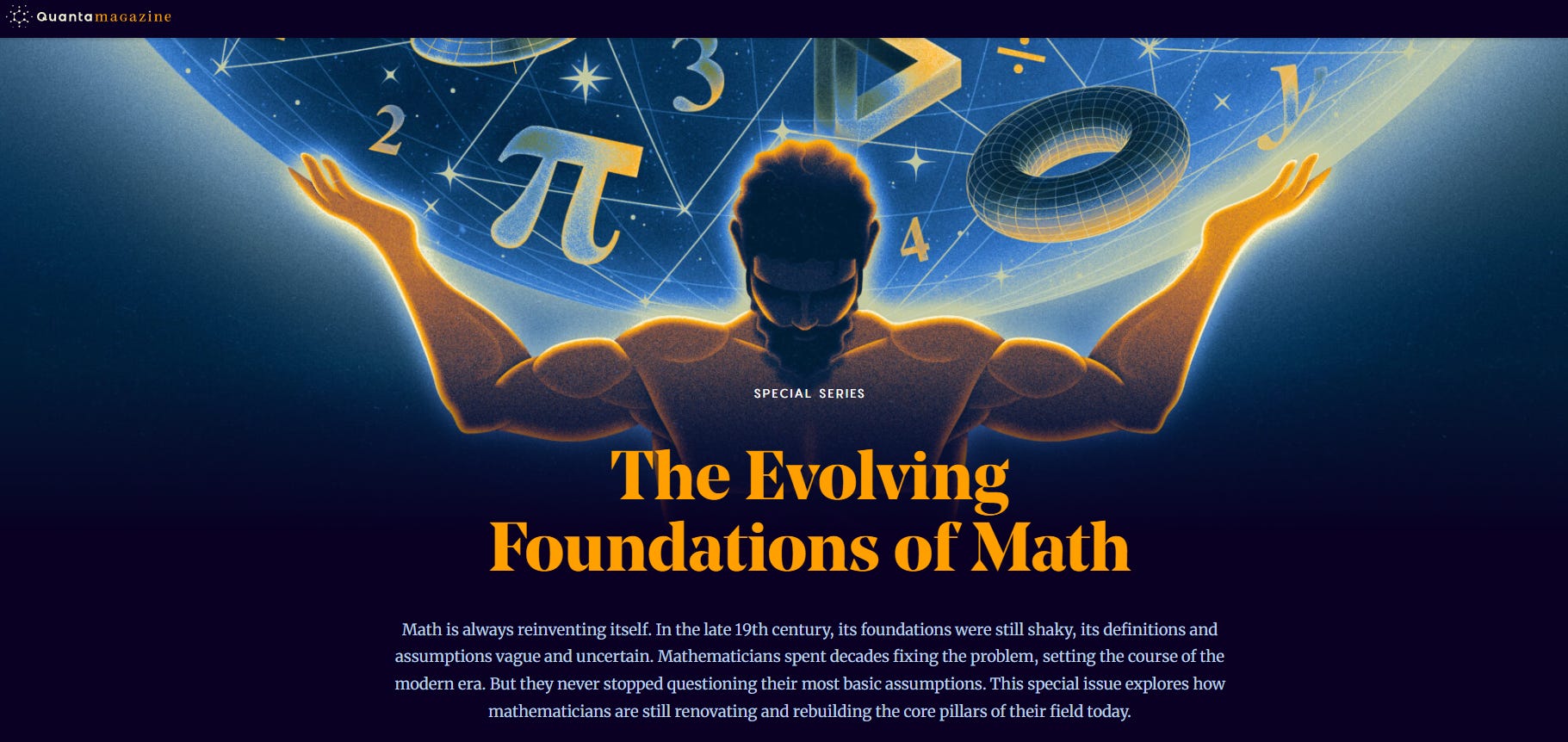
From analysis and history covering The Evoling Foundations of Math to the interview of Terence Chi-Shen Tao, the Fields-Medal winning Australian-American mathematician, in How Terry Tao Became an Evangelist for AI in Math, to A Tenacious Explorer of Abstract Surfaces on how ‘Maryam Mirzakhani’s monumental work draws deep connections between topology, geometry and dynamical systems’, I have sampled how writers untangle tougher premise that our brains can’t process yet. It was impressive that these wordsmiths unwrapped higher math with flair and finesse. I yearned to become such a writer myself, an expert in spinning dense thesis with ease. As the saying goes, “Easy reading requires tough writing.”
Before reaching the easy, there’s often a hill of problems to climb. This got me to think…
Fearing problems? Try Pólya’s Way
All my school and college days, I hated math. My teachers just attacked the problem at hand, without helping me think why I needed to solve them, or where it came from, or how should I think of a solution. It was all just a grim set of numbers, x and y. What the heck does f(x)|2 dx < ∞ even mean! Ugh!
However, this fear was cracked open during a Statistics Course that I took as part of the Liberal Arts Program (the Young India Fellowship) at Ashoka University. Taught by UPenn Professor Santhosh Venkatesh aka Prof. SV, he introduced us to “The Art of Solving Problems; Or What Would Pólya Do?”. [See screenshot from the class note]
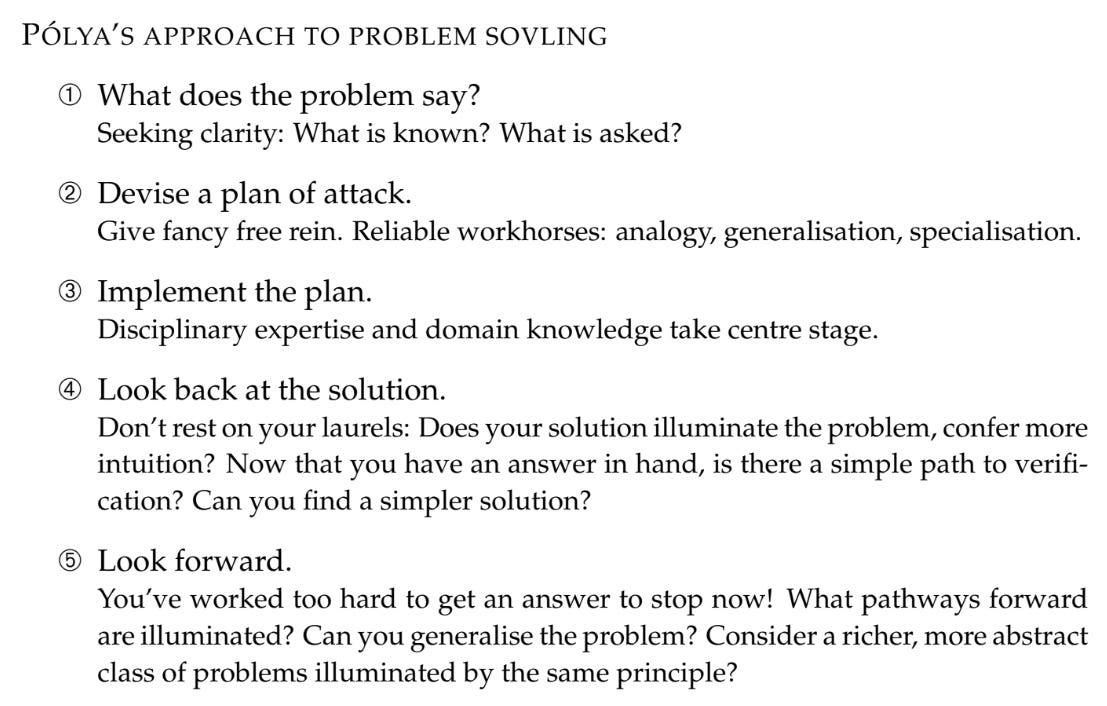
Prof. SV kept reiterating that he didn’t want the right answers but only wanted us to record our process of thinking and how we are coming up with possible solutions. This shift was so crucial because ALL MY LIFE I have been barraged with math problems that kept pushing me to find x. What the heck man?!
This shift by Prof. SV made me wonder:
Was I taught math the wrong way all my life?
Won’t it be cool to ask questions about questions themselves?
Perhaps how we think of a solution is a better metric to advance our learning?
Maybe I would have been an actual engineer instead of scribbling in my notebooks as an act of rebellion!
Pólya’s method nudged me to think of problems with deeper curiosity, not fear. It forced me to set sail to find answers by exploration, not concern. As explorers, its vital to think before we chart our course. And writing can be a great tool to develop our thinking. But before we sit down to write, it is fundamental to build the right mindset to ask deeper humane questions, which leads me to…
How to Develop Our Questioning Brain
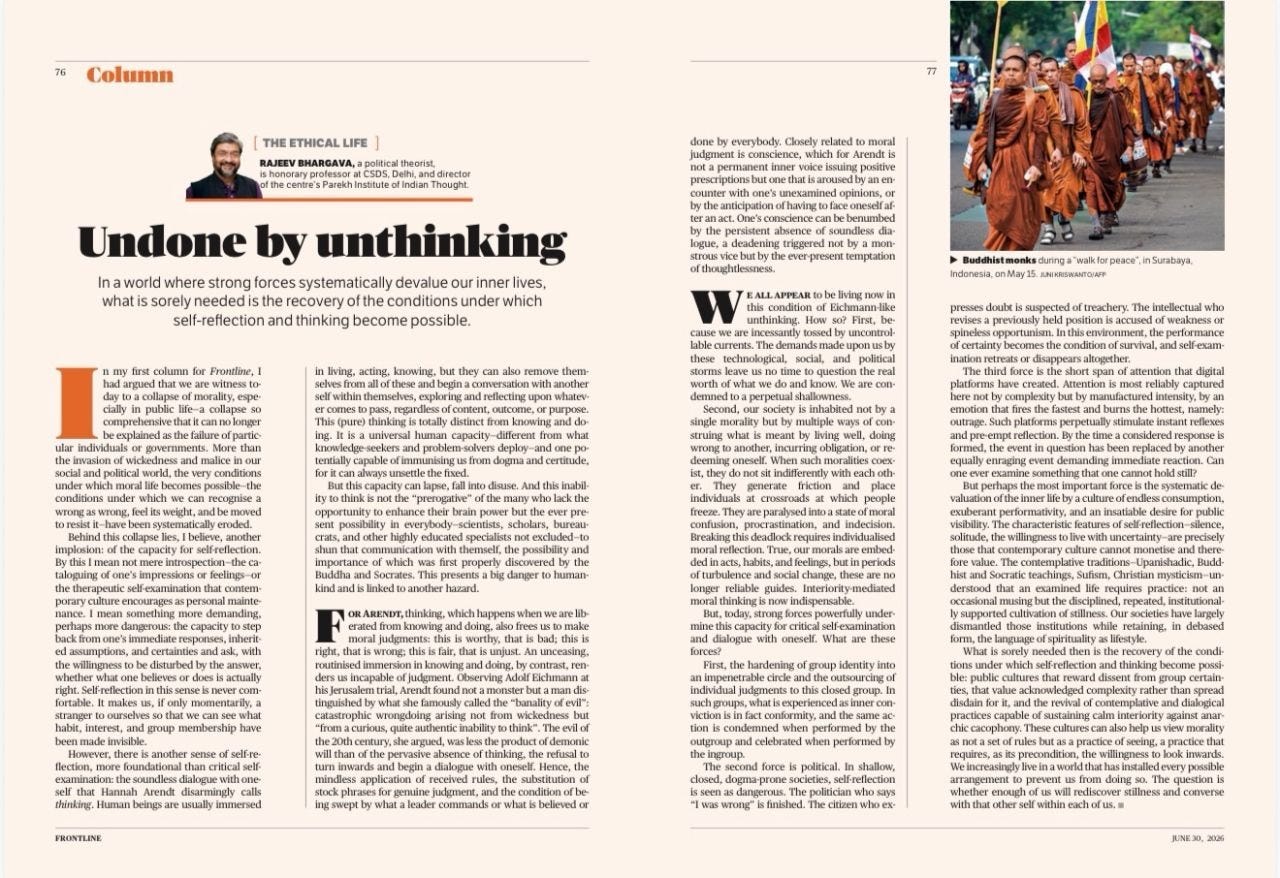
In the essay, “Undone by unthinking“ by Rajeev Bhargava says, “In a world where strong forces systematically devalue our inner lives, what is sorely needed is the recovery of the conditions under which self-reflection and thinking become possible.”
He points out the cost of attention loss due to social media: “Attention is most reliably captured here not by complexity but by manufactured intensity, by an emotion that fires the fastest and burns the hottest, namely: outrage. Such platforms perpetually stimulate instant reflexes and pre-empt reflection. By the time a considered response is formed, the event in question has been replaced by another equally enraging event demanding immediate reaction. Can one ever examine something that one cannot hold still?”.
Every day we see crises one after the other. The constant barrage of this chaos from genocide reports to war to corruption has resulted in no time to self-reflect. Self-reflection happens ONLY when we ask questions about complex issues affecting our daily lives. Hence, for starters, it is vital to ask questions about things we fear or things that doesn’t make sense to us in both personal and professional lives.
Writing can be one of the greatest method as a self-reflection activity. Writing can also be a great creative exploration tool. To build the latter, I try developing the wordsmanship — art of chiseling away difficult subjects and say it clearly with style.
In “Writing to Learn” by William Zinsser (author of one of the greatest non-fiction books “On Writing Well”) speaks about his interaction with Joan Countryman, the Head of Mathematics Department at Germantown Friends School in Philadelphia.
In the chapter “Writing Mathematics”, Joan discloses how she involves writing in her teaching to help her students chip away the fear of math by urging them to write letters about the sums. [Refer the pages below]
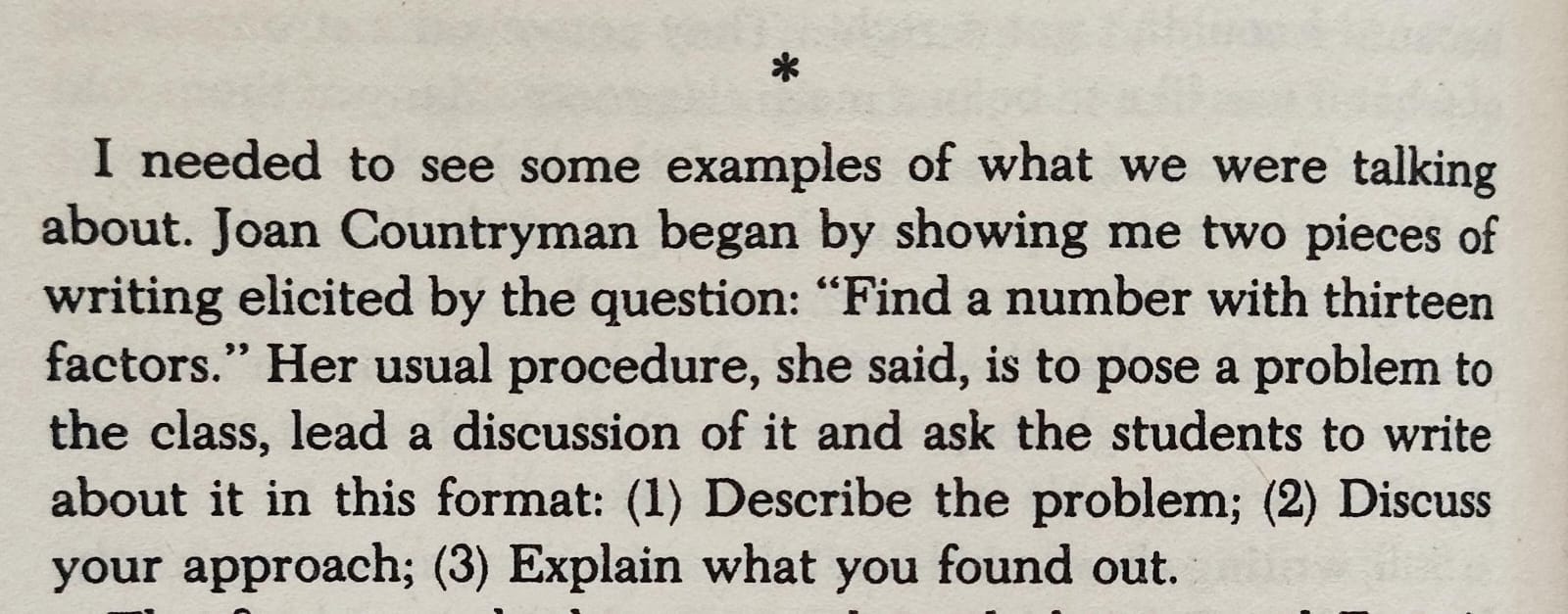
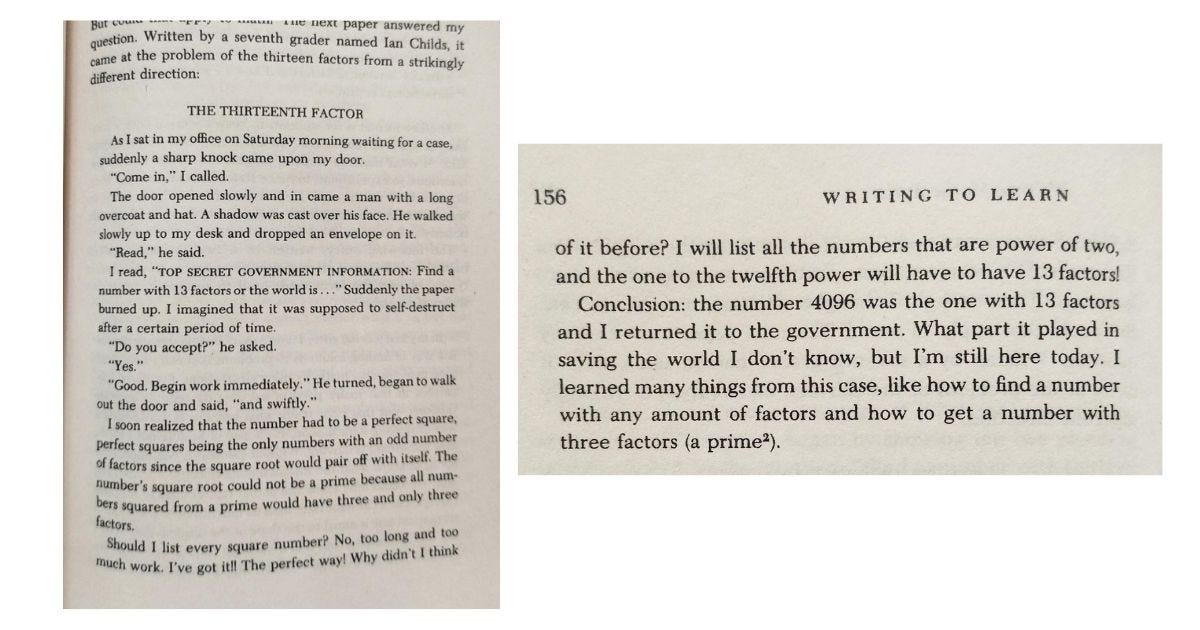
In this form of writing encouraged by Joan, her students captured their raw thinking. And as they wrote, their thinking evolved. As their thinking evolved, so did their perspective on the problem at hand. That’s the whole point of writing —
You write not to find ONE solution but to know who you are
You write to help build your thinking muscle that can push you get multiple possible solutions
This is a mental dexterity that develops over time.
Just like how Joan noticed the transformation that writing offered to her students, I get the same upbeat feeling when working as a ghostwriter. It sure does feel lively when I see founders’ thinking unfold when they share anecdotes for the detailed questions I pose regarding their work.
And speaking of questions, this leads me to…
Mathematicians Guide to Questions & Story Foundations
A mistake I made when I began writing publicly on social platforms was that I just wrote whatever was trendy and followed the templates of popular thought-leaders. I shared hacks, tips, and tricks on varied topics. Naturally, my writing style was too shallow as I wrote pieces that were like ‘How to do XX to achieve YY’.
Bleh! I was only adding the same POV to the noisy feed, not offering anything of value. I did try the Speculative Journalism framework, where I ask myself a series of questions on what to expect in a particular field (just the way how I ask my ghostwriting clients too)
To stand out, I had to do tougher reading i.e., access supreme long-form essays and reportage. Reading such works will help me learn how to improve my own artistry and also learn how to develop the prowess to ask the right questions. I decided to mix myself into a mathematicians mindset and here’s what I found:
No brainer; follow the works of writers you love! — In The OpenNotebook, mathematics journalist with over 20 years of experience Erica Klarreich, in the explanatory ‘Mathematics Reporting: An Uncrowded Niche for Writers’ stresses why it’s crucial to reach out to research driven individuals.
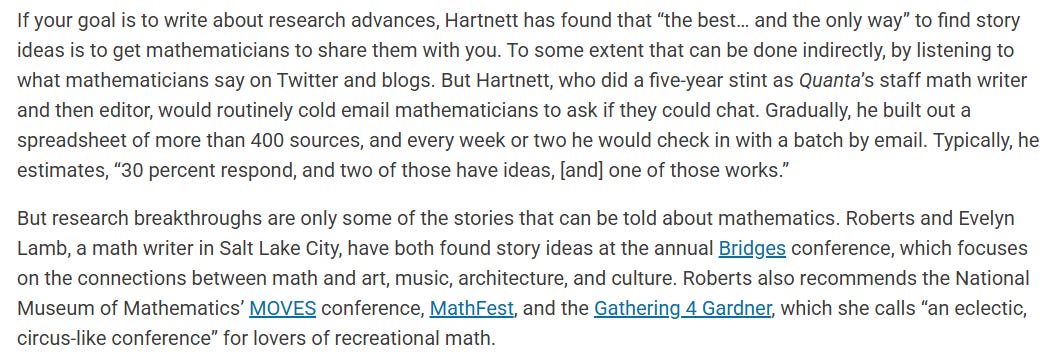
Reading Erica’s piece reminded me of a similar essay by Eleanor Warnock for Every.to: The Heyday of the Writing-first Practitioner. Eleanor notes professionals are figuring out that the ones who write publicly about their field, their mistakes, their process, or their opinions are building something that a job title never could. These are people who write to think, not just to market themselves.
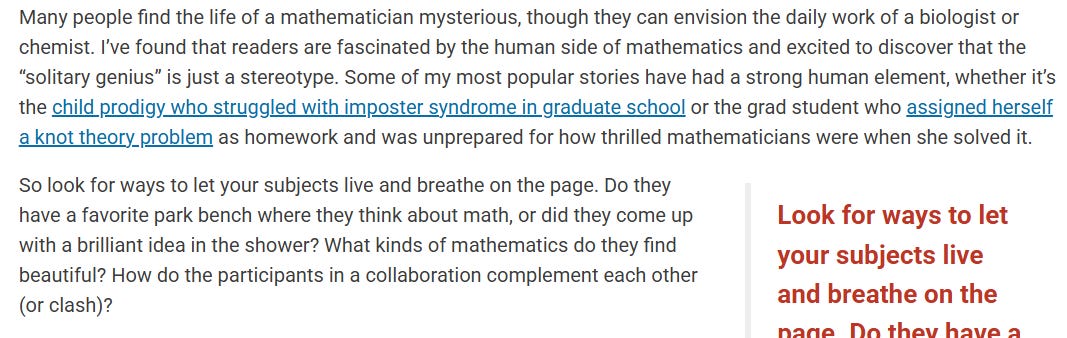
Of course, many are yapping on LinkedIn or Substack these days. Most are sadly doing this with AI. But the ones who stand out are the folks who know this; the best way to tell a complicated story is to tell the human side of it.
Read this segment by Erica in the same piece:
To tell great stories, we need to keep the foundations strong — Consider the advice by Terence, the Fields Medal winning mathematician. In this blog post ‘Write professionally‘, he says:
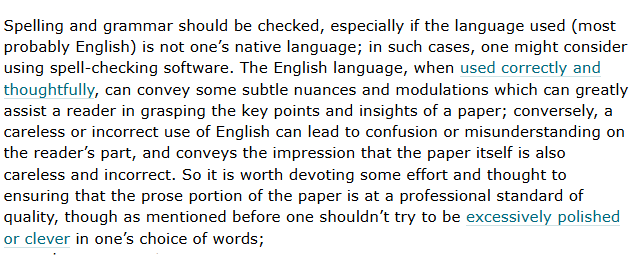
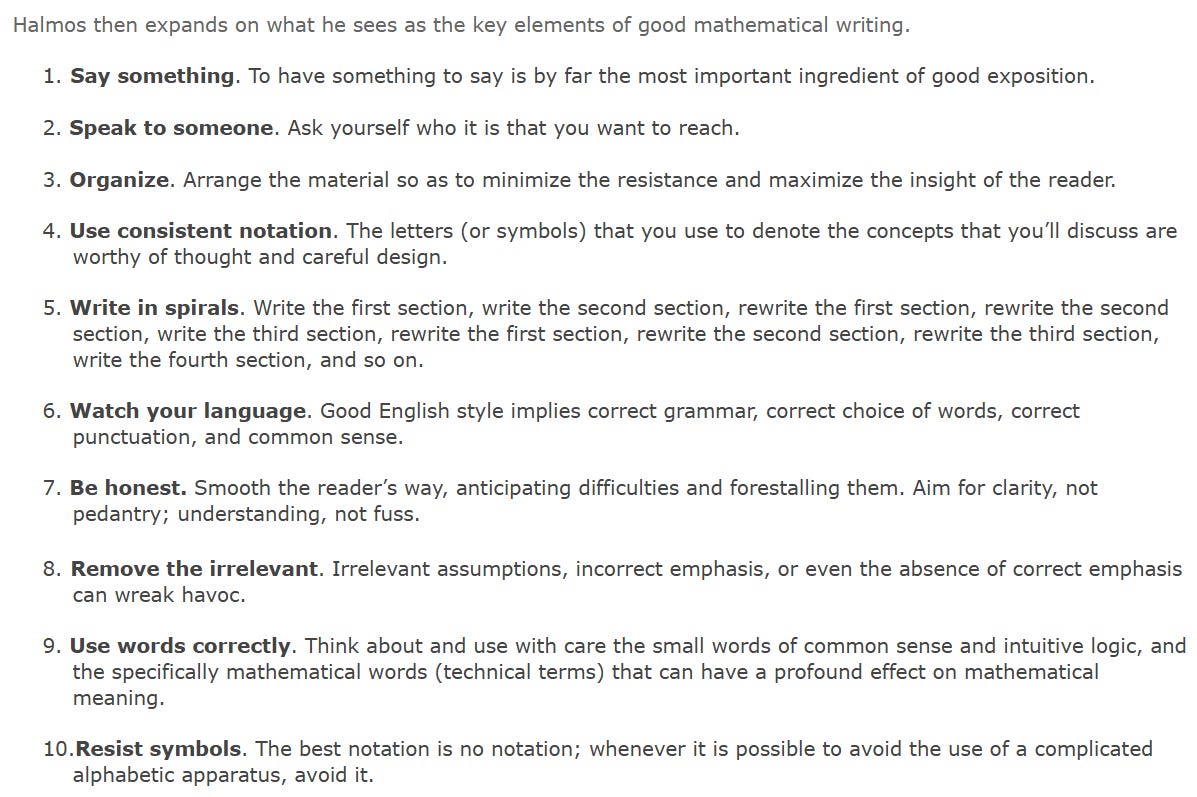
Ten tips to good writing, the mathematicians way! — Thanks to regular reading of Quanta Magazine, I was introduced to the work of another great mathematician Paul Halmos who penned down ‘How to write mathematics’. This blog post ‘The Mathematical Tourist’ lists his recommendations:
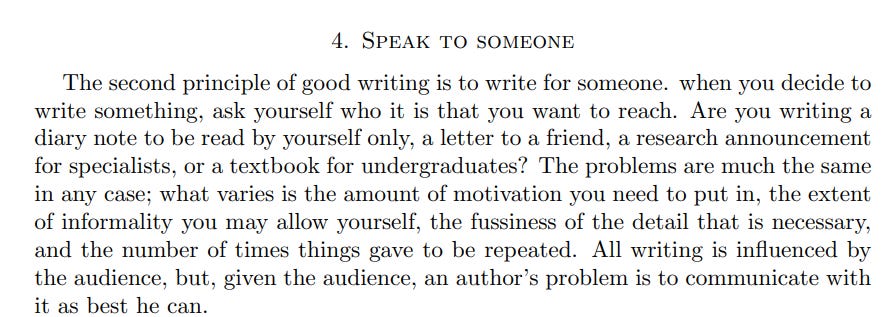
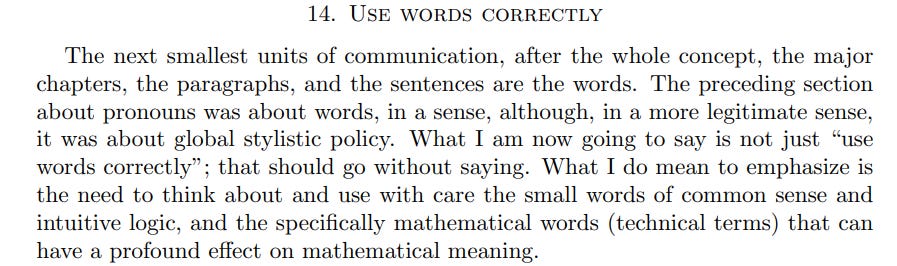
I wanted to go further and here’s a core section from Paul’s book:
Trust in the process but know it takes practice and patience — When I rewrite my writings with numerous attempts, it certainly feels heavy. Sample the section from Erica’s piece we discussed earlier:
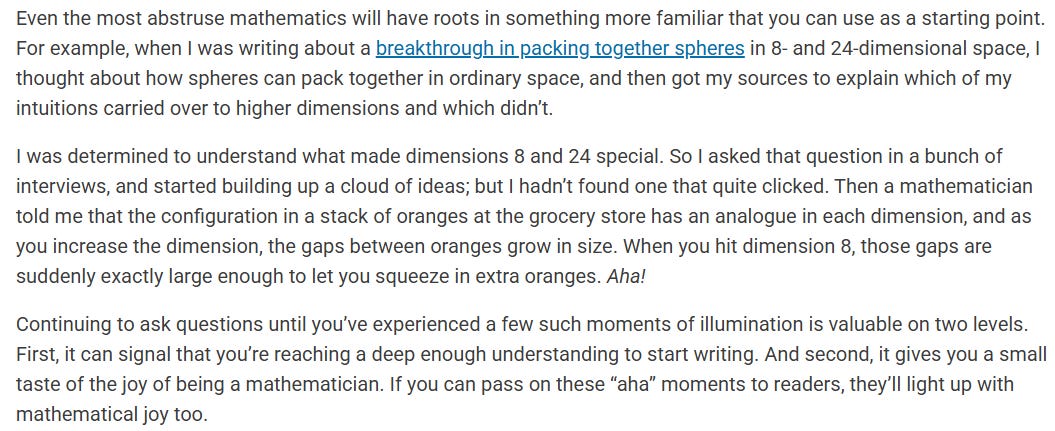
Read far and wide to develop taste for diverse styles — I stumble upon human pieces by journalists writing about difficult STEM subjects. Take this -- My Fantastic Voyage at Quanta Magazine. The ‘Founding editor-in-chief Thomas Lin looks back at a decade of Quanta journalism and forward to what’s next for the magazine’. It’s a beautiful curation of all the well-researched high quality writing on science and math produced by the team.
Reading Thomas’ note felt like a call-out to William’s ‘Writing Mathematics’ chapter from his book ‘Writing to Learn’.
He says, “Listening to these examples, I saw that many of my beliefs about writing and learning also apply to mathematics: that we write to discover what we know and don’t know; that we write more comfortably if we go exploring, free of the fear of not being on the “right” road to the right destination, and that we learn more if we feel that the work has a purpose. Motivation is as important in mathematics writing as in every other kind of writing.”
Once I allow the dumb words to simmer into my draft, rough hard thoughts of my brain slowly make sense as words on screen.
Then I work on another draft and another draft because, “We write to discover what we know and don’t know”.
That's the whole point of writing and the mathematician's way of telling stories!
And that’s all for today!
Did you like reading this edition? Should I do better? Please don’t hesitate to offer me your feedback. I am open to ideas and suggestions.
Feel free to reach me at rayaanjournalist@gmail.com or you can simply reply to this email or comment below. See you soon! 😊❤️