

Welcome to the Fiction Emailer: A newsletter that aims to make sense of our chaotic world through the lens of ‘Speculative Journalism & Fiction’ by rayaan_writer. Find here long-form essays and interviews that will help you think clearer, read sharper, write better, and look forward to an optimistic future. Visit my site to know more.
Join My WhatsApp Channel: Every other day, I send you one article worth your time… curated for people who think before they scroll. [Link]
My LinkedIn feed lately has two perspectives by founders and professionals:
AI is going to take your writing job.
Writing will always exist despite AI.
After tech giants like Anthropic and OpenAI put out a hiring net for copywriters, there has been an optimistic chatter among comms professionals and writers, all sighing in relief that their future is secured (or atleast for now).
I assumed the same and was hopeful myself, until I read: “The Companies Building the Machines That Write Are Paying $400K for Humans Who Can. That Should Tell You Everything.”
This segment from the analysis pasted below stood out for me:

The key sentence is: “[The comms/writing job role]…requires judgment about audience, competitive positioning, cultural context, and organizational identity that gets built up over years of doing the thing.”
After reading, I had to rewire my assessment of the hiring news with a sense of cautious optimism. I wanted to adopt a practical mindset.
To get further context of what led these AI companies to hire, I read another piece from April by the same publication: “Every Company Now Sounds Like ChatGPT and That’s the Biggest Brand Opportunity in a Decade”.
I’ve pasted the core portion of this essay below:

This line stood out: “[If the company uses AI to write], the company doesn’t trust its own voice.”
It’s a punchline no founder, CEO or a solo entrepreneur should ignore. I find it strange how someone can offload their writing to AI, and expect customers to buy their product or service, or simply just read their “writing”.
It’s not rocket science to know that a key foundation to build a strong business is communication. You can be the next big thing in any line of business if you are someone who articulates and speaks well. This skill can be built if you write regularly. Your writing need not be public (atleast in the beginning). And you need not do it just for the sake of hitting the publish button. You do it to develop your thinking muscle.
Imagine you write from the first day of your journey as an entrepreneur; the odds may certainly be in your favour; from attracting partnerships to finding mentors to forging relationship with potential customers who can become your lifelong well-wishers.
Yeah yeah bro, we get it!!!
Everyone should write but what about us — writers who are yet to find a comms job or any job where we can write?
I’d point such a person to this practical guide by Every.to: How to Start a Career When AI Is Doing Your Entry-level Job.
From this piece, the writer Katie hits a SIX with the words below:
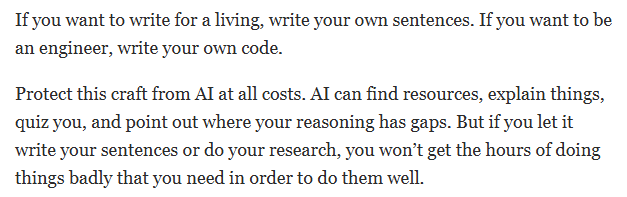
I am seriously considering to put this in my wall: “Protect your craft from AI.”
Like any skill, the edge can only be sharpened until and unless you make mistakes.
AI, unfortunately, prevents you from making mistakes. Every time you write something gibberish, dump it on AI and then let it edit, what happens is that we don’t really see the grammatical or narrative changes it does. All we do blindly is copy-paste. Many always simply just ask AI to “write a 500 word essay on XXX”.
Thus, building the foundational muscle by reading some key books such as
On Writing by Stephen King,
On Writing Well by William Zinsser,
The Art and Business of Online Writing by Nicholas Cole,
and Bird by Bird by Anne Lamott can make a difference.
You can always read about writing but remember -- your writing output should be more than your input that you do to read about writing.
Some habits that continue to hone my skills include:
Practicing to write by hand in my notebook everyday.
Using tools like Wispr Flow so that I can yap a lot directly to my laptop or phone.
Anytime I pick a piece of a newspaper or a book, I scribble what I feel on the corner of the pages with a pen.
If I want to write about something, I first send a voice note to my loved ones who give feedback on what they feel about my idea in its clay-form.
Remember, writing is thinking, and thinking can be sharpened every day, like how you go to the gym to stay fit.
And if I have to romanticize writing, then all I say is its perhaps one of the greatest gifts and miracles that we can experience as humans.
Why should we even dump all of this into an AI bot when we should experience it ourselves?
As for comms professionals and content writers, do check out the pieces below:

The core nutgraf of Noema’s essay states:
“One of the great ironies of this new machine age is that it seems set to rehabilitate, quite precisely, the value of the traditional ‘liberal arts’ education.”
“This is an arena where liberal arts-informed thinking, storytelling, historical analogy, ethical reasoning and cross-domain curiosity become tangible competitive advantages.”
Finally, for brands and businesses looking to standout when AI makes everything sound the same, do yourself a favour and read this piece below:

Finally, to every writer out there, for the love of God, just keep writing and develop core skills that will be your leverage from using AI as your sparring partner for creative work (and not a replacement) to adopting liberal-arts problem solving frameworks.
The universe eventually rewards those who play the long-term game.
And that’s all for today!
Did you like reading this edition? Should I do better? Please don’t hesitate to offer me your feedback. I am open to ideas and suggestions.
Feel free to reach me at rayaanjournalist@gmail.com or you can simply reply to this email or comment below. See you soon! 😊❤️