

Welcome to the Fiction Emailer: A newsletter that aims to make sense of our chaotic world through the lens of ‘Speculative Journalism & Fiction’ by rayaan_writer. Find here long-form essays and interviews that will help you think clearer, read sharper, write better, and look forward to an optimistic future. Visit my site to know more.
Join My WhatsApp Channel: Every other day, I send you one article worth your time… curated for people who think before they scroll. [Link]
Look at the illustrations below.
On the left is Minas Tirith from the Lord of the Rings, and on the right is the City of Tashbaan in the Narnia series.
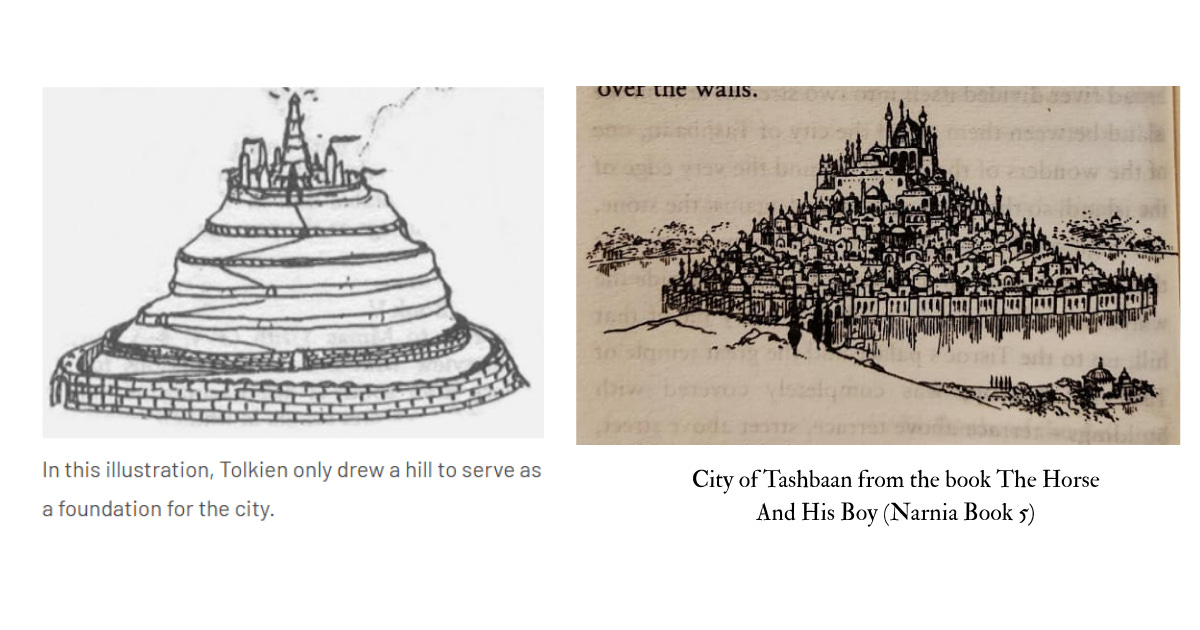
Don’t you find it similar?
It’s an upside-down cone, and has the same style of spires, walls, and roads.
As a fan, I obsess over such cities of fictional universes including Lord of the Rings, Narnia, Star Wars, or Harry Potter. I’m baffled by the effort that writers of these worlds put in to make them so real.
When I saw the city of Minas Tirith and Tashbaan, I was intrigued by how nearly identical they looked. Did J.R.R. Tolkien and C.S. Lewis copy each other?
Certainly not but I did have a pleasant shock when I learnt that they were actually friends. As members of the ‘Inklings’ club, Tolkien and Lewis met every week at a pub to read drafts and give feedback alongside other 19 or so writers.
Can you imagine your writing critiqued by the greatest of world-builders? What would Tolkien speak about my style? He’d banish me to Mordor until I improve my art for words. What about Lewis? He too may have thrown me in some wretched place of Narnia.
I ended up asking questions on having a creative partner
This further went downhill in my mind and soon I was left with:
First, why do we need one?
Second, what happens to partnerships when most of us rely on AI?
Since Tolkien and Lewis were friends, perhaps each other got influenced by the other’s literary universe that they were building. Tolkien is quoted as saying he couldn’t have finished LOTR without the support of Lewis.
In the earlier editions, I wrote why we need offline activities to keep our brain raw, without the influence of AI to prevent ourselves from offloading our thinking.
I have written on Why Every Online Writer Needs an Offline Compass, Why To Write No Matter The ‘Perfect’ AI, and about developing taste In How To Write Curations That Outlast AI.
The core message from the above essays are:
WRITE BY HAND, then use voice dictation tool to yap and later use your laptop to work manually on your first draft.
Read a lot and don’t really trust AI summaries because you need to know when you should do the full reading to get the complete depth of a topic.
Consider doing offline activities such as drawing maps, and note-taking directly using your pen or a pencil, when you read something on your phone or a laptop.
What about using AI tools for ‘creative partnerships’?
Now before you think I am pushing for using AI completely as your creative partner, I’d say wait till the end of this piece. I have been adopting certain AI hacks nevertheless for the writing and research work I do.
First, paste the prompt below in your Claude and store it as instructions under your relevant Project Folder.
This prompt prevents from hallucinating and is brutally honest. It sort of feels like the good old days of manually Googling and scouring through links to find the right source of whatever info you’re digging around with armed caution and judgment.
[Btw, you can read this too that I wrote a fortnight ago:]

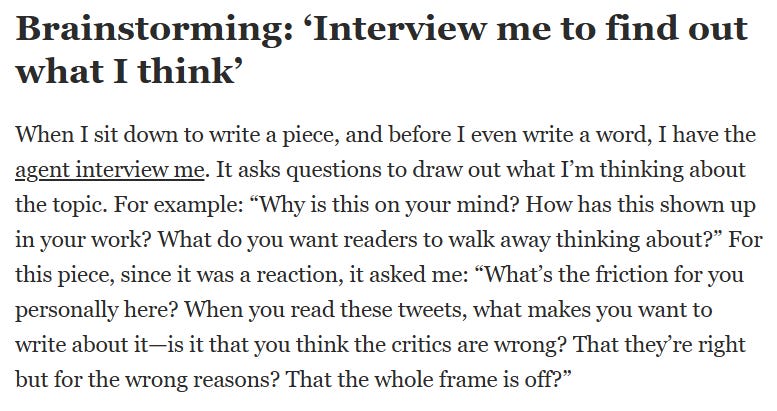
Second, read ‘Writing With AI is Harder Than You Think’ by Katie Parrott of Every.to, who says ‘it takes rigor, judgment, and willingness to be told your work isn’t good enough.’
The headline might make you think it’s entirely ‘writing’ using AI but that’s not the case. Sample a section pasted below of how Katie expands her thinking of a topic she sets out to write.
I adopt a somewhat similar method as proposed by Jay Dixit, who was the Head of Community for Writers at OpenAI. I use the prompt below:
“I’m working on [x]. My goal is [y]. Do NOT attempt to write it for me. I want all the ideas to come from me. Your job is to ask me questions to help me clarify my goals for the project, help surface my own best ideas, and push me to express myself with clarity and precision.“
Here, the key sentence from the prompt is Do NOT attempt to write it for me.
I then start writing my first draft by referring to my hand notes and online research stored in Notion. I do this by thinking out loud, i.e., yapping into my laptop using Wispr Flow by answering the questions Claude asks me on the topic I’m about to write.
Thirdly, what follows is JENGA STACKING. Just like how we move the wooden blocks of Jenga to build a tower, I move around sentences in my own accord to understand the flow and structure of the essay.
I start off by spending a lot of time figuring out the headline, the strap line, and two to three subheadings. This acts as the overall skeleton in need of the bones — the sentences here and there.
I don’t offload this step to AI because doing this manually, the old-school way, helps me get the feel of what my reader can experience as they progress through my essay.
In the entire process of my writing, I use AI to ask me questions on my writing which pushes me to think deeper. It brings a perspective that I didn’t have a clear vision before. But I still need to balance this with human intervention, which leads me to…
Your Family & Friends As Editors To Your Creative Work
It’s worth revisiting my essay How Grace, Niche & Cringe Help
Here I wrote on why we need family and friends when we build something in public:
“It is ideal to centre your writing at the hero of your niche: the community interested in this topic. When we treat our audience as our heroes, we go deep into their topic, the problems they face, the solutions that already exist, and how we can offer a different perspective and take.
To bring this out in your writing, the best trick to adopt is to share your writing or talk about the ideas in draft with your family, a friend, a spouse, sibling or your parents. When these are the people you think of as your first reader, you adopt an easy to understand writing style…”
Apart from my brothers, I have phone calls with my close set of friends on a million things related to work and life. I also have accountability partners. One of my dear friend, Shruti Bajaj who works at Ashoka University reminds me to take a walk, while I message her that she should start writing more often on LinkedIn. We exchange ideas, takes on relationship, work, life, and more. I ask her gazillion questions and I appreciate her thinking.
Human conversations really make a difference. Many of my writing have taken shape thanks to a different angle that my brothers or friends tell me in random moments.
Do I want AI to act as my creative partner? Absolutely not! It is just binary. It is ones and zeros, and great at pattern recognition, telling you what’s the likeliest output that can happen.
But I’d prefer my own Inkling Club any day, all day, just like how J.R.R. Tolkien and C.S. Lewis gave feedback and admired each other’s work. My brothers and friends know who I am, what I do, and what’s the best version they want me to be, and speaking to them builds a creative partnership that I know will have life-long endurance.
Further Reading:


And that’s all for today!
Did you like reading this edition? Should I do better? Please don’t hesitate to offer me your feedback. I am open to ideas and suggestions.
Feel free to reach me at rayaanjournalist@gmail.com or you can simply reply to this email or comment below. See you soon! 😊❤️