

Quick List
“The Examined Life in the Age of Optimisation” by Rodney King for the New York Journal of Philosophy.
“How Our Leisure Time Got Monetized” by Ted Gioia for The Honest Broker
“10 Best Writing Advice By Top LinkedIn Writers” by Yours Truly.
“Writes and Write-Nots” by Paul Graham.
“How to Turn An Idea Into an Essay (in 4 hours). A practical system for turning scattered thoughts into something worth reading” by Kaguura Gichuru
“The Lived Experience Miner for LinkedIn” by writer Matt Barker.
‘Writing to Learn: How to Write--And Think--Clearly about Any Subject at All’ by William Zinsser
Welcome back Essay 5 of ‘The Long-Term Game’ Curatorial Reads Delivered Every Monday on Thought Leadership Thinking: Learn how accomplished founders and professionals write & think to build their niche expertise, and apply the same frameworks yourself.
The Case of Not Niching Down as a Writer Before Niche Writing
It is sad social media optimisation dictates what we choose to write.
That should not be the case!
Especially if you’re a founder, a professional looking to write on LinkedIn.
Why can’t we write whatever we want?
But it’s hard as I too end up forcing myself to write trending topics.
The way my first hour unfolds after posting an atomic LinkedIn essay is a bit unhealthy: I toggle in between infinite tabs in my browser to keep track of my metrics: saves, reshares, likes, or comments. I do a comparative analysis of my past and current posts; Has it grown, fallen or the same?
And when my brain generates a visual chart of the performance, my energy fizzles out like a pressure cooker. Why is nobody reading? Why such low impressions?
Sigh.
Join My WhatsApp Channel to get curated readings. No spam. Just Wisdom.
Questions When the Going Gets Tough
LinkedIn writing is scary as hell.
It could even be mentally taxing if you are in the business of getting leads.
LinkedIn is a game of trial-and-error smartest-tricks-wins. The path to victory for thought leadership content in this platform is laid out with new unexpected hurdles as you climb each level. A sure shot way to armour yourself as you race on this platform is high-quality real human writing.
But sometimes even writing well doesn’t work out.
I lose my shit when I come across dumb posts with random selfies of random person with AI slop shitty written wisdom or startup bros spitting AI sermons of ‘it is not X but Y’. The annoying part is when such cringe posts get humongous response, whereas people like me put their blood, sweat, and tears to crack up a 200 word note.
When artificial thought cookies get the upper hand, I am left with questions:
How do you fight the social media engagement envy?
How do you push away creators who tell you are doing it wrong?
See, I know honest heartfelt human writing will survive the test of time. But to reach that state of mind, to reach the zen mode of “I-don’t-give-a-damn-about-the-platform-AND-I-WILL-WRITE-WHAT-I-WANT,” requires a different mindset, which leads me to…
The Invisible Disease of Optimisation
If you click on the first link in any Wikipedia article and you keep clicking, it will eventually lead you to philosophy article.
Similarly, the root of any thought leadership content can be traced to life optimisation.
Take this essay by the New York Journal of Philosophy, “The Examined Life in the Age of Optimisation” by Rodney King.


Our life has become a focus on productivity, efficiency, and the like.
Think of the posts you read on LinkedIn. It is flooded with quick takes such as:
5 Leadership Lessons in X
How to Become a Better Manager
Tips to Hire
How to Schedule Your Life
10 Things CEOs Do In The Morning
We also keep repeating the same circle of content in different formats from LinkedIn carousels to quotes that nudge you to comment to get links.
All of them teach us how we can do X to achieve Y.
But what if we do not follow the conventional wisdom of writing ONLY what works, and rather just write for the sake of writing, regardless of trending topics?
There are some genuinely good LinkedIn writers like Nicolas Cole or Dickie Bush who are masters of such writing. Many of their posts are indeed actionable and practical.
And like Rodney King, I’m not totally against optimisation or scheduling of my life.
It’s just that social media platforms are designed to make us self-doubt.
Thanks to gazillion half-baked thought cookies that get unnecessary attention, it forces us to believe these are the ONLY thinking frameworks or living principles that we should live by and should be written about.
We are all victims of over optimisation.
On days when I miss my writing target, I get upset.
But I do realise over optimisation wears me down.
The days I write well are the days when I do writing as a creative exploration rather than a mechanical task… writing for the love of it, for the art of it.
In “How Our Leisure Time Got Monetized,” Ted Gioia writes for The Honest Broker about his father, how he’d spend his free time — a life way before optimisation existed.

Everyone will prefer the best storytellers!
In my essay that I curated last week, I referred to writers like Mike Rosenberg, Paula Simpson and Harsh Snehanshu. (You can click below to read more)

These are writers who write for the sake of writing. I love how they think.
I believe no matter which platform you write for, any over-mechanical framework-driven optimisation-focused content WILL have a shelf life.
But what if you lace it with stories? It CAN surely outlast.
Soulful writing can stand the test of time.
And it begins ONLY when you treat your writing as an act of exploration like a cartographer.
Popular essayist and programmer Paul Graham, says “The result will be a world divided into writes and write-nots.”
He points out in the future there will only be good writers and those who cannot write, and there won’t be any in between.
This is because people will just be dumping all their thinking into AI and therefore lose the ability to write themselves. It is bad for society.
But Rayaan, it is not easy to be indifferent to the demands of the platform.
The obvious routine wisdom is to double down on what is trending and niche so you serve your target community, and then you scale up on LinkedIn.
Yes, yes, yes to all of this!
My take is specifically for founders or professionals who are just starting to write on LinkedIn, who are here to understand what kind of writing will give them joy, and what kind of idea exploration will give them the drive to be excited.
Remember, writing with the intent of a long-term goal will always shine.
In “The Examined Life in the Age of Optimisation”, Rodney King adds, “…Holding your own mortality steadily in front of you does not make you gloomy so much as honest, and honesty about how little time there really is tends to rearrange what you do with it more quickly than any productivity system ever has.”
My interpretation is this:
it is indeed tempting to follow the crowd and write what other LinkedIn creators tell you to write.
You may want to follow other LinkedIn creators’ content system, calendar, or a productivity clock.
But the onus is on us to push back and do the writing first and foremost for ourselves.
Hence, it is the best not to niche down right in the beginning, at least in the first few months of your LinkedIn debut.
Therefore, I refer to the cartographer because when they create maps, they explore the globe not with the intent of finding the end destination but just to capture whatever exists on land from mountains to hills to rivers to streams to valleys to lands to rough oceans.
Know that our job as storytellers is this —
We write to understand who we are.
We write to figure out what we love to write.
We write to reflect what kind of writing we hate.
We write to think better and become better thinkers.
And finally, we write so that we can reach state of indifference to the demands of online performative existence.
This finally leads to answering founder’s question:
What should we write about?
When I watched The Odyssey on IMAX, I kept wondering how a 2,800-year-old story has endured the test of time. Think of all the classics from Greek mythologies, Indian folklore, to stories from West Asia and across the globe.
They have endured for centuries, and all were written way before AI. When kingdoms rose or empires fell, when trades flourished or collapsed, stories have thrived.
Today those who can actually write will still choose to go with the friction, the old-school way — writing with a pen and paper, writing with MS Word or a Google document, without the need for an AI tool to ‘help’ them.
While tech companies or creators push you for optimisation of life, I believe that it is in our best interest, for our own well-being and for society, to get a taste of many wide things - to take our writing as an explorative practice.
Write whatever you want.
Write things you actually care about.
Tools to get started
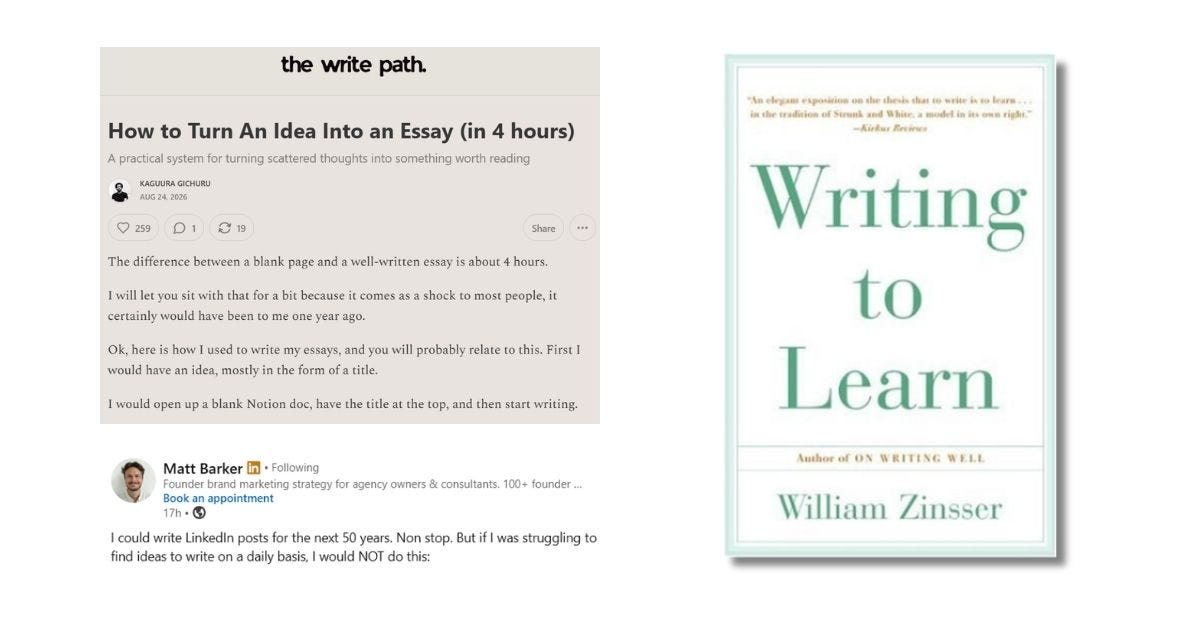
How to Turn An Idea Into an Essay (in 4 hours). A practical system for turning scattered thoughts into something worth reading by Kaguura Gichuru
The Lived Experience Miner for LinkedIn by writer Matt Barker.
‘Writing to Learn: How to Write--And Think--Clearly about Any Subject at All’ by William Zinsser
And that’s all for today!
Reach out to me on LinkedIn to say hi.
You can simply reply to this email or comment below. See you soon! 😊❤️